Traditional Touch, Modern Elegance: Beautiful Arabic Mehndi Designs
Mehndi has been part of celebrations, beauty traditions, and cultural expression for generations. Its appeal comes from something wonderfully simple: a temporary form of body art can turn ordinary hands into a canvas filled with flowers, leaves, curves, paisleys, and graceful patterns. Among the many styles available today, Arabic Mehndi Designs have developed a particularly strong following because they offer an attractive balance between traditional artistry and contemporary fashion. Instead of filling every inch of the skin with intricate details, Arabic Mehndi usually allows the design to breathe, creating a striking contrast between decorated and undecorated areas. This makes the style visually lighter while still giving the hands a sophisticated and noticeable appearance.
The modern popularity of Arabic Mehndi also comes from its flexibility. A flowing floral trail can be perfect for a casual gathering, while the same basic concept can be expanded into a detailed bridal arrangement for a wedding. Current 2026 bridal and festive trends are continuing to highlight negative space, flowing vines, bold florals, jewellery-inspired patterns, finger detailing, and Indo-Arabic combinations. Whether someone prefers a small design on the back of the hand or an elaborate pattern extending toward the forearm, Arabic Mehndi provides plenty of room for creativity. It is traditional without feeling old-fashioned, fashionable without losing its cultural character, and detailed without necessarily becoming visually heavy.
What Makes Arabic Mehndi Designs Special?
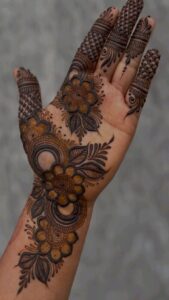
The most recognizable feature of Arabic Mehndi is its sense of movement. Rather than arranging motifs in a dense, symmetrical grid, artists often create sweeping trails that travel diagonally across the hand or wrist. Flowers become the main anchors, while leaves, tendrils, dots, paisleys, and curved lines act like bridges connecting one motif to another. This gives the design a natural rhythm, almost like a vine growing across the skin. The open areas surrounding those motifs are just as important as the henna itself because they provide contrast and make the darker portions of the pattern stand out.
Another reason Arabic Henna Designs are so appealing is their ability to suit different levels of decoration. Someone attending a small family celebration may choose a single floral vine, while a bride may request several interconnected floral clusters extending from the fingertips to the forearms. The basic visual language remains recognizable even when the amount of detail changes dramatically. Current design collections and bridal coverage continue to show Arabic patterns being adapted into simple back-hand designs, bracelet-style compositions, finger-focused patterns, and fuller bridal arrangements. This adaptability makes Arabic Mehndi less like one fixed design and more like a complete family of artistic styles.
The Signature Elements of Arabic Mehndi
Flowers, leaves, vines, paisleys, and curved stems form the foundation of many Arabic Mehndi compositions. Large flowers often serve as focal points, while smaller buds and leaves gradually guide the eye along the hand. A paisley can add a stronger traditional character, whereas thin vines and delicate dots can make the overall pattern feel lighter. Some artists also introduce geometric borders, lattice-inspired details, tiny chains, rings, or jewellery-like wrist patterns to give classic motifs a contemporary personality.
The magic is often in the arrangement rather than the individual motif. A beautiful flower by itself is attractive, but when it is positioned beside a curved vine and framed by leaves with carefully controlled empty space, the whole composition becomes more expressive. Think of it like decorating a room: placing every piece of furniture into every available corner can make the room feel crowded, while thoughtful spacing allows each important object to stand out. Arabic Mehndi follows a similar principle. The skin becomes part of the composition, and that balance between henna and open space creates the style’s signature elegance.
Traditional Beauty with a Modern Touch
Traditional Mehndi has never been completely separate from fashion. Designs change as clothing, jewellery, photography, celebrations, and personal preferences change, and Arabic Mehndi has proved particularly adaptable to those shifts. A traditional floral vine can be simplified, enlarged, rearranged, or combined with geometric details without losing its recognizable identity. This is one reason Simple Arabic Mehndi continues to work so well for modern celebrations. It can be understated enough for someone who dislikes heavy decoration while still giving the hands a festive appearance.
The modern interpretation is especially visible in the way artists use isolated motifs. Instead of covering the complete palm, an artist might place one large flower near the wrist and allow a thin trail to travel toward the fingers. Another option might use a central paisley with only a few leaves around it, leaving generous areas of bare skin. Contemporary bridal trends in 2026 are also emphasizing personalized storytelling, strategic empty space, region-inspired motifs, and designs that photograph well in close-up images. These choices demonstrate that modern Mehndi is not necessarily about adding more decoration; sometimes elegance comes from knowing what to leave out.
Why Negative Space Creates a Modern Look
Negative space is one of the strongest visual tools in Arabic Mehndi. It simply means allowing areas of the natural skin to remain visible between motifs rather than filling everything with lines and patterns. This creates breathing room and gives the main flowers, paisleys, and vines greater visual impact. When you look at an open Arabic pattern, your eyes naturally move from one decorated area to another, following the direction created by the flowing lines.
This technique also makes the design feel more contemporary. Heavy traditional patterns can create a rich, jewellery-like effect, but an open design can appear cleaner and more delicate. Recent 2026 trend reporting from India and the UAE points toward continued interest in minimal, wrist-length, jewellery-inspired, and negative-space-heavy Mehndi styles. For someone choosing a design today, that means there is no need to think of simple Mehndi as less beautiful. A thoughtfully planned minimal design can look just as intentional and sophisticated as a highly detailed one.
Popular Arabic Mehndi Design Ideas
There are countless ways to interpret Arabic Mehndi, which is part of its charm. You can start with a classic floral trail and adjust its size, direction, density, and level of detailing according to your personal taste. Some people prefer designs that begin at the fingertips and move toward the wrist, while others like a central flower surrounded by leaves and small decorative elements. The design can also be placed on the front hand, back hand, fingers, wrist, feet, or forearm depending on the occasion.
When selecting an idea, it helps to think about the final appearance rather than simply choosing the most complicated picture. Ask yourself whether you want something bold, delicate, traditional, modern, festive, or bridal. The best design is not necessarily the one containing the greatest number of motifs; it is the one that feels balanced on your hand and complements your overall appearance. Arabic Mehndi is particularly forgiving in this regard because even a small collection of well-positioned motifs can create an attractive result.
Floral Arabic Mehndi
Floral Arabic Mehndi remains one of the most versatile choices because flowers naturally create soft, feminine, and graceful compositions. Large roses, open flowers, small buds, curved petals, and leafy branches can be combined into a trail that travels naturally across the hand. The artist can use thick outlines to make the flowers visually strong and then add fine interior lines for depth. A few dots around the petals can provide additional texture without making the design crowded.
For a casual occasion, a single floral branch may be enough. For an engagement or wedding, the same idea can be expanded by adding multiple flowers, paisleys, detailed leaves, and decorative finger patterns. Floral Arabic patterns are also easy to coordinate with clothing because flowers are visually versatile and do not compete heavily with embroidery or jewellery. If your outfit already contains elaborate work, an open floral design can actually provide balance rather than adding another layer of visual complexity.
Arabic Mehndi for Fingers
Finger Mehndi is an excellent choice for people who want something fashionable without committing to a full-hand design. Individual fingers can feature tiny flowers, curved lines, leaves, dots, lace-inspired patterns, or simple bands. The designs may be connected to a larger motif on the back of the hand, or each finger can carry its own independent decoration. This makes finger Mehndi especially useful for modern events where a subtle but noticeable detail is preferred.
The finger-focused approach has become increasingly visible in contemporary bridal and festive designs because fingers are highly noticeable in photographs, especially when holding flowers, jewellery, invitations, or other wedding details. Current 2026 bridal inspiration highlights fingertip detailing and clean negative space as important elements of modern Mehndi aesthetics. A small amount of carefully positioned decoration can therefore create a polished appearance without covering the entire hand.
Bracelet-Style Arabic Mehndi
Bracelet-style Arabic Mehndi transforms the wrist into the visual centre of the design. Instead of applying a traditional pattern that simply stops at the wrist, the artist creates a band or jewellery-inspired arrangement that resembles a bracelet made from henna. Floral elements, chains, leaves, dots, paisleys, and small geometric details can be combined to create this effect.
This design is particularly attractive for parties, Eid celebrations, engagements, and modern weddings because it works almost like an accessory. It can be paired with bangles or worn alone, depending on the desired look. Jewellery-style wrist patterns and bracelet-inspired Arabic designs are among the contemporary styles highlighted in recent festive trend reporting. If you love the appearance of jewellery but want something lighter and more artistic, this style is worth considering.
Bridal Arabic Mehndi Designs
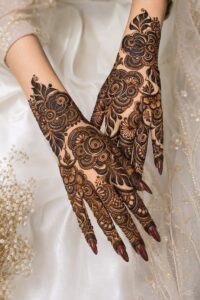
Bridal Mehndi allows artists to take the elegance of Arabic patterns and expand it into a much more elaborate composition. A bridal arrangement may cover both hands, continue toward the wrists and forearms, and combine flowers, paisleys, vines, finger details, geometric textures, and personalized motifs. The bride can choose how much coverage she wants, so Arabic bridal Mehndi does not have to mean extremely dense decoration. A carefully planned open design can still create a dramatic bridal effect.
What makes Bridal Arabic Mehndi especially interesting is the possibility of mixing styles. A large Arabic flower can become the central motif while smaller Indian-inspired paisleys, jaali details, or personalized symbols fill selected areas around it. This produces a rich design without sacrificing the open quality that makes Arabic Mehndi distinctive. Contemporary bridal coverage in 2026 continues to show interest in Arabic and Indo-Arabic patterns for brides who want bold visual impact without necessarily choosing completely packed hands.
Arabic Bridal Patterns for Modern Brides
A modern bride can personalize almost every aspect of her Mehndi. Initials, meaningful symbols, wedding dates, small motifs representing a shared interest, or other personal details can be incorporated subtly into the larger design. Instead of hiding every personalized element inside dense artwork, an artist can position it within an open composition where it becomes easier to discover.
The key is to maintain visual balance. Too many personalized elements can make the design feel like a collection of unrelated stickers rather than one coherent artwork. A skilled artist can integrate those details into flowers, paisleys, borders, vines, or jewellery-style patterns so they feel like a natural part of the composition. The result can be both traditional and deeply personal—a design that looks beautiful from a distance and becomes more meaningful when viewed closely.
Minimal Arabic Mehndi Designs
Minimal Mehndi is perfect for people who appreciate elegance without heavy decoration. A single flower, one curved vine, a small paisley, a wrist band, or a few decorated fingers can be enough to create a sophisticated appearance. The beauty of minimal Arabic Mehndi comes from restraint: every line has a purpose, and every open space helps frame the design. Instead of asking, “How much Mehndi can I fit on my hand?” the better question becomes, “Which few elements will make my hand look its best?”
This approach works particularly well for birthdays, office celebrations, family gatherings, festive lunches, engagement events, and casual parties. It can also be a practical option when you want to show your jewellery or manicure. Current trend reports show that younger customers are increasingly requesting finer, minimal, jewellery-inspired, and wrist-length patterns rather than only choosing heavy traditional designs. That shift shows how Mehndi is becoming increasingly flexible as a fashion accessory as well as a cultural art form.
Simple Designs for Everyday Celebrations
A simple Arabic design does not have to look plain. The secret is choosing a strong focal point. For example, one large flower surrounded by three or four leaves can create a complete composition if the lines are clean and the spacing is deliberate. A thin vine extending toward one finger can add movement, while a few dots can finish the pattern without overwhelming it.
Beginners can also find this style easier to practice because they can concentrate on a limited number of motifs. Once comfortable with flowers, leaves, paisleys, and curved stems, those elements can be combined into increasingly sophisticated patterns. The important thing is consistency: smooth lines and balanced spacing usually contribute more to the beauty of a simple design than excessive detailing.
Indo-Arabic Mehndi: The Best of Both Styles
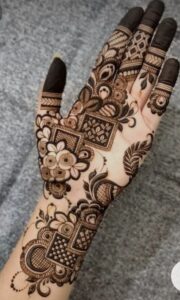
Indo-Arabic Mehndi brings together two different visual approaches. Arabic influence is often visible through flowing vines, bold flowers, large motifs, and generous negative space, while Indian influence can appear through paisleys, jaali patterns, mandalas, peacocks, fine fills, and intricate detailing. The result can be richer than a purely minimal Arabic design while still retaining the movement and openness that define Arabic aesthetics.
This fusion has become a popular contemporary choice because it offers flexibility. A bride may choose a large Arabic floral trail and introduce Indian-inspired details inside selected flowers or around the wrist. Someone attending a festival could use a smaller version with one paisley and a few geometric elements. Current 2026 bridal reporting specifically identifies Indo-Arabic combinations as a continuing design direction, particularly where flowing Arabic lines meet Indian decorative motifs.
Combining Bold Arabic Florals with Indian Details
The most successful fusion designs usually avoid giving equal visual weight to every element. One style acts as the foundation while the other adds accents. For example, flowing Arabic vines can create the overall structure, while Indian-style jaali fills and paisleys provide detail within selected sections. This keeps the composition readable instead of turning it into an overcrowded mixture.
The beauty of this approach is that it can be personalized to almost any celebration. You can make it soft and minimal by using only a few Indian details, or make it elaborate by adding dense patterns around the main Arabic flowers. The artist essentially gets two artistic languages to work with, creating a design that feels familiar but not predictable.
Arabic Mehndi Designs for Different Occasions
The occasion should influence the size, density, and personality of your Mehndi design. For a wedding, elaborate floral trails and Indo-Arabic combinations can create a luxurious appearance, while an engagement may call for a medium-sized design with jewellery-inspired wrist details. For Eid or another festive celebration, a graceful back-hand floral pattern or finger design can be enough to create a beautiful traditional touch without requiring hours of application. For a casual event, a simple vine or small paisley may be the ideal choice.
Matching the design to the event also prevents the Mehndi from competing with your outfit. A heavily embroidered outfit already contains plenty of visual information, so an open design may provide a more elegant balance. Conversely, if you are wearing a relatively simple outfit, a larger Arabic floral pattern can become an attractive statement feature. Think of Mehndi as part of the complete look rather than an isolated decoration.
Choosing the Right Arabic Mehndi Design
Choosing an Arabic Mehndi design becomes easier when you consider four things: the occasion, your outfit, your preferred coverage, and your personal style. If you love delicate details, look for fine vines and small flowers. If you prefer something bold, choose large floral motifs with stronger outlines. If you dislike full-hand designs, focus on the back hand, fingers, or wrist. If you want something traditional but fashionable, Indo-Arabic fusion can provide a useful middle ground.
Hand shape can also influence how the pattern appears. Long flowing trails can visually emphasize the length of the hand, while a central motif can create a stronger focal point. Finger designs can make jewellery and manicure details more noticeable, while a wrist band can frame bangles beautifully. There is no universal “best” Arabic Mehndi design because the most flattering option depends on the person wearing it.
Matching Mehndi with Your Outfit
Your outfit can provide excellent inspiration for your Mehndi. If you are wearing floral embroidery, you can echo one or two flower shapes in your design. If your outfit features geometric embroidery, small lattice or geometric Mehndi details can create visual harmony. Gold jewellery can pair beautifully with jewellery-style Mehndi patterns, while colourful festive outfits can be complemented by a classic brown henna design that does not introduce another competing colour.
Sleeve length also matters. A wrist-focused design works beautifully with shorter or rolled-up sleeves because the pattern remains visible. A forearm-extending bridal design can create a more dramatic effect when paired with traditional wedding clothing. The goal is not to copy your outfit exactly but to create a visual conversation between the clothing, jewellery, and Mehndi.
Front-Hand vs Back-Hand Arabic Mehndi
Front-hand Arabic Mehndi can be more noticeable during traditional gestures, dancing, ceremonies, and photographs where the palms are visible. It can feature larger flowers, paisleys, vines, and open spaces while leaving selected areas of the palm undecorated. Back-hand designs, on the other hand, are often particularly popular for their fashion-forward appearance because they can resemble delicate jewellery placed across the hand.
Neither placement is automatically better. If you want your Mehndi to be visible in everyday photographs and while wearing rings, a back-hand design can be a strong choice. If you want a more traditional festive appearance, front-hand decoration may be preferable. You can also combine both by using a more detailed palm design with a lighter back-hand pattern, or vice versa.
Arabic Mehndi Design Trends in 2026
The biggest trend in 2026 is not simply “more detail.” Instead, current bridal and festive inspiration points toward personalization, negative space, bold floral motifs, bracelet-style bands, finger detailing, geometric accents, and Indo-Arabic fusion. Many modern designs are intentionally structured so that the hand remains visually open rather than completely covered. This approach makes the artwork easier to appreciate and can also work particularly well in close-up wedding photography.
There is also a noticeable movement toward jewellery-inspired Mehndi. Wrist bands, ring-like details, delicate chains, and finger patterns can create the impression that the wearer is carrying a permanent accessory made entirely from henna. UAE trend reporting in 2026 has highlighted a preference among younger customers for minimal and elegant patterns, including wrist-length designs, finer detailing, and jewellery-style motifs. These trends fit naturally with Arabic Mehndi because the style already depends heavily on graceful lines and strategic spacing.
How to Make Your Mehndi Look More Elegant
Elegance begins before the cone touches your skin. Choose a design that matches your hand, clothing, jewellery, and occasion instead of selecting a complicated pattern simply because it looks impressive in a photograph. Make sure your hands are clean and free from heavy creams or oils before application, because a clean surface helps the design apply more consistently. Give the artist enough time to work carefully rather than rushing through complicated details, especially for bridal Mehndi.
After application, follow the artist’s recommended aftercare instructions and allow the paste to dry properly. The stain may develop and deepen over time, so the colour immediately after removing dried paste is not necessarily the final appearance. Most importantly, avoid choosing a product solely because it promises an unusually dark or instant-black stain. The U.S. FDA warns that products marketed as “black henna” may contain PPD, an ingredient associated with potentially serious skin reactions, and advises consumers to be cautious about such products.
A beautiful Mehndi experience should also be a safe one. Ask the artist what product is being used and be cautious about products with unclear ingredients or claims of producing an unnaturally dark stain immediately. Natural henna typically produces shades in the brown, orange-brown, or reddish-brown range, while additional ingredients may be used to create other colours. If you have concerns about a product or experience irritation, seek appropriate professional medical advice rather than continuing to use it.
Conclusion
Arabic Mehndi Designs beautifully demonstrate how traditional art can evolve without losing its identity. Flowing floral vines, bold flowers, paisleys, delicate leaves, open spaces, and graceful curves give Arabic Mehndi a distinctive appearance that works across weddings, festivals, engagements, parties, and casual celebrations. Its greatest strength is flexibility: the same artistic language can produce a tiny finger design, a jewellery-inspired wrist pattern, a simple back-hand motif, or an elaborate bridal arrangement.
In 2026, the style continues to move toward thoughtful personalization and modern simplicity, with negative space, finger details, bold florals, bracelet-style patterns, and Indo-Arabic combinations remaining important sources of inspiration. That makes this an exciting time to explore Arabic Mehndi because there is no single rule telling you what your design must look like. Whether you choose Simple Arabic Mehndi, an elegant floral vine, a sophisticated bracelet pattern, or a detailed Bridal Arabic Mehndi design, the best choice is the one that reflects your personality and complements your celebration. Traditional beauty does not have to stay in the past; with the right creative touch, it can become something fresh, fashionable, and completely your own.